•  
Dancers perform at port tourism promotion event

Dancers perform at port tourism promotion event

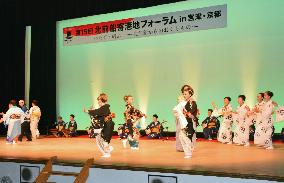
KYOTO, Japan - Dancers perform in Miyazu, Kyoto Prefecture, on July 25, 2014, at the 15th Kitamaebune Port of Call Forum, an event aimed at promoting tourism at major Japanese port cities where "Kitamae" merchant ships stopped from the Edo period through the Meiji period.

  •  
Opening of Yakumo Koizumi museum in Greece

Opening of Yakumo Koizumi museum in Greece

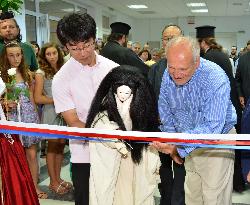
LEFKADA, Greece - A Seiwa Bunraku puppet from Kumamoto Prefecture, southwestern Japan, cuts the tape on July 4, 2014, to celebrate the opening of a memorial museum for Meiji-period writer Yakumo Koizumi, whose real name was Lafcadio Hearn, on Greece's Lefkada island where he was born in 1850. He moved to Japan and lived in such places as Kumamoto and Matsue.

  •  
150th year of educator Niijima's departure for U.S. marked

150th year of educator Niijima's departure for U.S. marked

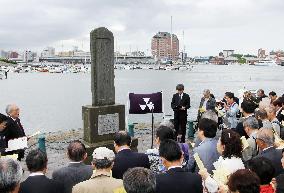
HAKODATE, Japan - A ceremony takes place at Hakodate port in Hokkaido, northernmost Japan, on June 14, 2014, to celebrate the 150th anniversary of Jo Niijima's departure for the United States. Niijima was a Japanese missionary and educator in the Meiji period (1968-1912), who founded Doshisha University in Kyoto, western Japan.

  •  
Japanese Christians appreciate returned painting of Virgin Mary

Japanese Christians appreciate returned painting of Virgin Mary

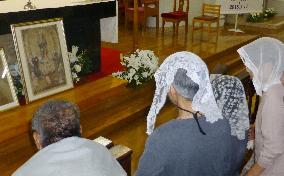
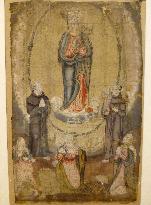
NAGASAKI, Japan - Christians gather before a painting of Virgin Mary, brought to France from Nagasaki, southwestern Japan, early in the Meiji period (1868-1912) and returned to its original place on May 29, 2014, after a hiatus of 145 years.

  •  
Painting of Virgin Mary returns to Nagasaki from France

Painting of Virgin Mary returns to Nagasaki from France

NAGASAKI, Japan - A painting of Virgin Mary, brought to France from Nagasaki, southwestern Japan, early in the Meiji period (1868-1912), returns to its original place at a church in the Nagasaki Archdiocese on May 29, 2014, after a hiatus of 145 years.

  •  
Dainippon Sumitomo Pharma displays Meiji era equipment

Dainippon Sumitomo Pharma displays Meiji era equipment

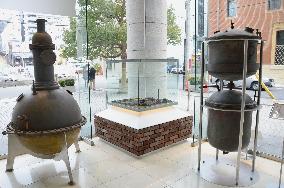
OSAKA, Japan - Dainippon Sumitomo Pharma Co. begins displaying equipment for manufacturing medicine and other purposes from the Meiji period at its head office in Osaka on March 25, 2014.

  •  
Photo exhibition on Japan in Switzerland

Photo exhibition on Japan in Switzerland

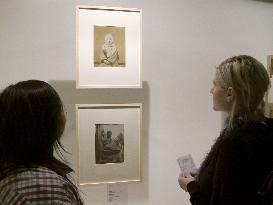
LUGANO, Switzerland - Visitors look at photos capturing life in Japan around the end of the Edo period (1603-1867) and the early Meiji period (1868-1912) at an exhibition in Lugano, southern Switzerland, on Feb. 1, 2011. Some 200 photos at the exhibition, which runs through Feb. 27, include those taken by well-known photographers Felice Beato, Kimbe Kusakabe and others. The photos, which were originally black and white, were later hand-colored.

  •  
Photo exhibition on Japan in Switzerland

Photo exhibition on Japan in Switzerland

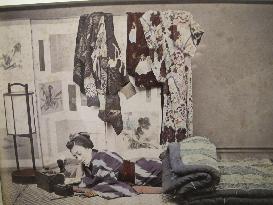
LUGANO, Switzerland - Photo showing life in Japan around the end of the Edo period (1603-1867) and the beginning of the Meiji period (1868-1912) is one of some 200 photos, many on public display for the first time, at an exhibition in Lugano, southern Switzerland, on Feb. 1, 2011. Photos at the exhibition, which runs through Feb. 27, include those taken by well-known photographers Felice Beato, Kimbe Kusakabe and others. The photos, which were originally black and white, were later hand-colored.

  •  
Photo exhibition on Japan in Switzerland

Photo exhibition on Japan in Switzerland

LUGANO, Switzerland - Photo showing life in Japan around the end of the Edo period (1603-1867) and the beginning of the Meiji period (1868-1912) is one of some 200 photos, many on public display for the first time, at an exhibition in Lugano, southern Switzerland, on Feb. 1, 2011. Photos at the exhibition, which runs through Feb. 27, include those taken by well-known photographers Felice Beato, Kimbe Kusakabe and others. The photos, which were originally black and white, were later hand-colored.

  •  
Photo exhibition on Japan in Switzerland

Photo exhibition on Japan in Switzerland

LUGANO, Switzerland - Photo showing life in Japan around the end of the Edo period (1603-1867) and the beginning of the Meiji period (1868-1912) is one of some 200 photos, many on public display for the first time, at an exhibition in Lugano, southern Switzerland, on Feb. 1, 2011. Photos at the exhibition, which runs through Feb. 27, include those taken by well-known photographers Felice Beato, Kimbe Kusakabe and others. The photos, which were originally black and white, were later hand-colored.

  •  
Old Edo, Meiji period maps in vogue

Old Edo, Meiji period maps in vogue

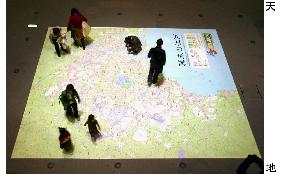
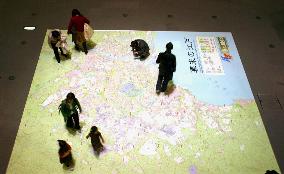
TOKYO, Japan - A large map of the capital Edo on the floor of the exhibition hall at the Edo-Tokyo Museum is immensely popular with visitors to the museum.

  •  
Upper house all-out to make its presence felt

Upper house all-out to make its presence felt

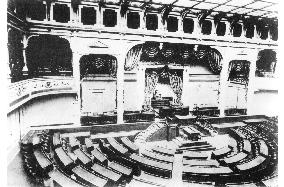
TOKYO, Japan - The floor of the House of Peers, the upper house's predecessor during the Meiji Period (1968-1912)

  •  
New notes to be issued in Nov.

New notes to be issued in Nov.

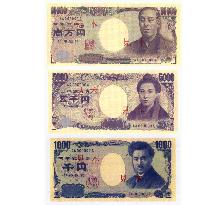
TOKYO, Japan - The Japanese Finance Ministry plans to issue three kinds of new notes in November using forgery prevention technology. The 10,000 yen note (top) features Yukichi Fukuzawa (1835-1901), educator, writer and propagator of Western knowledge in the Meiji period (1868-1912), the 5,000 yen note (middle) Ichiyo Higuchi (1872-1896), female writer of the Meiji period, and the 1,000 yen note (below) Hideyo Noguchi (1876-1928), bacteriologist.

  •  
Memorial held to remember Meiji gov't-backed Ainu assimilation

Memorial held to remember Meiji gov't-backed Ainu assimilation

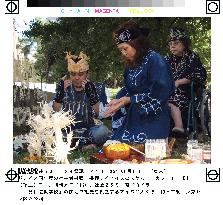
TOKYO, Japan - Three Ainu people offer their prayers at a vacant lot in Tokyo on Aug. 10 in the first memorial for indigenous Ainu people who were forced to leave their homes in Hokkaido and study in the capital during the early Meiji Period (1868-1912). The memorial was held at the former site of a school, Kaitakushi Kari Gakko, and styled after a traditional Ainu ceremony dedicated to their ancestors.

  •  
Data on Japanese emigrants to Hawaii to be available online

Data on Japanese emigrants to Hawaii to be available online

YAMAGUCHI, Japan - The Museum of Japanese Emigration to Hawaii, located in Oshima, Yamaguchi Prefecture, western Japan, will next month launch a research service to allow the emigrants' descendants to obtain information on their ancestors who sailed to the Pacific islands in the late 19th century. The museum will post information online on about 29,000 Japanese who emigrated to Hawaii to work in the sugar industry between 1885 and 1894, under a government-led program during the Meiji Period (1868-1912).

  •  
Statue of General Saigo - Ueno Park, Tokyo, Japan

Statue of General Saigo - Ueno Park, Tokyo, Japan

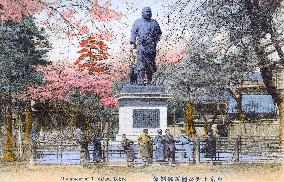
Statue of General Saigo Takamori (Takanaga) (1828-1877). Saigo was one of the most influential samurai in Japanese history, living during the late Edo Period and early Meiji Era. He has been dubbed the 'last true samurai'. The famous bronze statue shown here (of Saigo in hunting attire with his dog) stands in Ueno Park, Tokyo, Japan. Made by Takamura Koun, it was unveiled on 18 December 1898. Date: circa 1910s

  •  
Expert points to historical importance of naval dock in southern Japan

Expert points to historical importance of naval dock in southern Japan

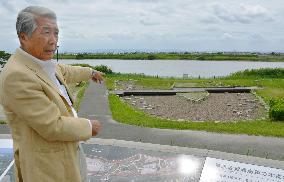
Toshitsugu Haji, head of a civilian group studying cultural heritage in Saga Prefecture, southwestern Japan, talks about the historical importance of the Mietsu Naval Dock, built by the Saga feudal domain near the end of the Edo period (1603-1867), in the prefectural capital on June 20, 2015. The facility is one of the candidate sites of the Meiji-era (1868-1911) industrial revolution Japan is seeking to have registered on the UNESCO World Heritage list. (Kyodo) ==Kyodo

  •  
Man in news: British buyer of old photos taken in Japan

Man in news: British buyer of old photos taken in Japan

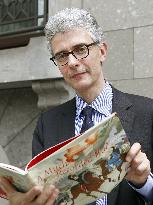
Sebastian Dobson, a British collector and buyer in Europe of Japanese photos taken in the late 19th to early 20th centuries, poses in Tokyo on May 19, 2015. He says photos taken between the end of the Edo shogunate era and the Meiji period tended to be better kept in Europe. (Kyodo) ==Kyodo

  •  
Imperial couple visit Emperor Meiji exhibition

Imperial couple visit Emperor Meiji exhibition

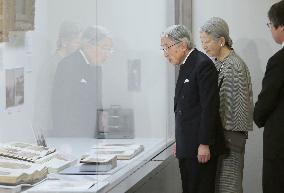
Japanese Emperor Akihito and Empress Michiko visit an exhibition featuring photos of buildings and sites visited by Emperor Meiji, or Emperor Mutsuhito, who reigned in the Meiji period from 1867 to 1912, at the Museum of the Imperial Collections in the East Gardens of the Imperial Palace in Tokyo on March 6, 2015. (Pool Photo by JiJi Press) (Kyodo) ==Kyodo

  •  
Entrance to Japan's oldest river tunnel in Kobe

Entrance to Japan's oldest river tunnel in Kobe

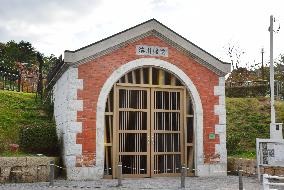
Photo taken on Oct. 17, 2015, shows the entrance to Minatogawa Zuido, Japan's first full-fledged tunnel built under a river in Kobe, western Japan, during the Meiji period (1868-1912). (Kyodo) ==Kyodo

  •  
Unique concert held in Japan's oldest river tunnel in Kobe

Unique concert held in Japan's oldest river tunnel in Kobe

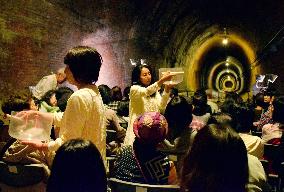
A fantastical music concert is held with crystal singing bowls on Oct. 17, 2015, in Minatogawa Zuido, Japan's first full-fledged tunnel built under a river in Kobe, western Japan, during the Meiji period (1868-1912). (Kyodo) ==Kyodo

  •  
Old Edo, Meiji period maps in vogue

Old Edo, Meiji period maps in vogue

TOKYO, Japan - A large map of the capital Edo on the floor of the exhibition hall at the Edo-Tokyo Museum is immensely popular with visitors to the museum. (Kyodo)

  •  
A traditional boat

A traditional boat

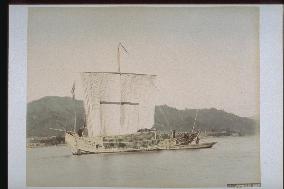
A large cargo ship in the Yamato style. From the design of the ship, it is believed to be of the later Kitamae period. Kitamae boats were active between the Edo era and middle Meiji era for trade with Hokkaido.==Date:unknown, Place:Nagasaki, Photo:unknown, (Credit:Nagasaki University Library/Kyodo News Images) [Cabinet Number6‐27‐0]

  •  
Autumn tints of Takinogawa, Oji

Autumn tints of Takinogawa, Oji

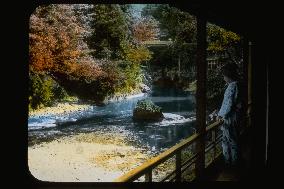
A woman looking at Otonashi River (Shakujii River) from a restaurant in Oji. The river was so clear during the Edo Period that tea made from river water was praised for its high quality. The hillside along the Otonashi River was also suited for tea growing, and the tea grown here was valued on a par with the famous tea from Uji. People were probably able to enjoy this tea here. Taken from a magic lantern made around 1897, this photograph shows that the river was still clean in the Meiji Period.==Date:unknown, Place:Tokyo, Photo:unknown, (Credit:Nagasaki University Library/Kyodo News Images) [Cabinet Number98‐50‐0]

  •  
Cherry trees by the Edo River

Cherry trees by the Edo River

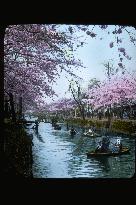
The Kanda Josui (waterway) stretching from around Sekiguchidai in Koishikawa and Iida Bridge was called Edo River (different from the tributary of Tonegawa). It is said that cherry trees were planted here in 1884, but despite its shallow history, the area became a famous cherry blossom viewing site called the new Koganei by the end of Meiji Period. Several boat houses provided lodgings and rented out small boats of this kind. It was a refined pleasure to view the cherry blossoms from the boat. This is a magic lantern slide made around 1897.==Date:unknown, Place:Tokyo, Photo:unknown, (Credit:Nagasaki University Library/Kyodo News Images) [Cabinet Number98‐35‐0]

  •  
Lake Ashi

Lake Ashi

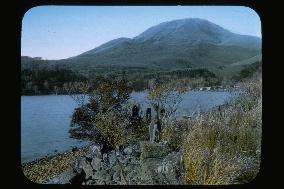
This photo captures the old town of Motohakone, with Mt. Komagadake viewed from Sainogahara by Lake Ashinoko. It is known that Sainogahara had many stone towers and stone Buddhas druing the Edo Period according to Tokaido Hakone Sanchu-zu (Ukiyoe; Color woodblock print of Hakone's everyday life in Edo period by Gountei Sadahide, 1863). This photo was taken after 1868 when Haibutsukishaku (anti-Buddhist movement at the beginning of the Meiji era) took place and many stones were destroyed or broken .==Date:unknown, Place:Hakone, Photo:unknown, (Credit:Nagasaki University Library/Kyodo News Images) [Cabinet Number98‐32‐0]

  •  
Going down the Hozu River

Going down the Hozu River

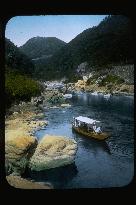
A yakata boat descending Hozu River is seen from the northern bank. The Kyoto Railway Company tracks and a tunnel are visible on the right. People took the approximately 16km boat ride from Hozu Town in Kameoka to Togetsu Bridge in Arashiyama. The river boats that carried lumber and goods from Tanba Kameoka to Kyoto were converted to leisure boats at the end of the Meiji Period when the Kyoto Railway was established. This photograph was taken sometime after August 1899, when the line between Kyoto and Sonobe opened.==Date:1904, Place:Kyoto, Photo:unknown, (Credit:Nagasaki University Library/Kyodo News Images) [Cabinet Number98‐11‐0]

  •  
Fishing in the Hozu River

Fishing in the Hozu River

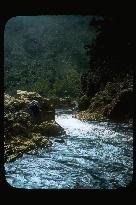
A man is fishing at Hozu Gorge, wearing a hand towel on his head and holding a long fishing rod over the rapids. People took the approximately 16km boat ride from Hozu Town in Kameoka to Togetsu Bridge in Arashiyama. The river boats that carried lumber and goods from Tanba Kameoka to Kyoto were converted to leisure boats at the end of the Meiji Period when the Kyoto Railway was established.==Date:1904, Place:Kyoto, Photo:unknown, (Credit:Nagasaki University Library/Kyodo News Images) [Cabinet Number98‐10‐0]

  •  
A pilgrimage near Lake Kawaguchi

A pilgrimage near Lake Kawaguchi

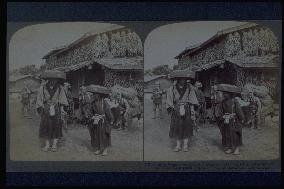
The caption says Pilgrims beating little gongs -- house covered with drying corn, near Lake Kawaguchi, Japan. The man and woman wearing bamboo hats and holding beads and bells appear to be pilgrims, but their religious affiliation is unclear. This photograph, which shows harvested corn drying on the houses in the background, provides valuable insights into lifestyles of the Meiji Period.==Date:1904, Place:Yamanashi, Photo:Underwood, (Credit:Nagasaki University Library/Kyodo News Images) [Cabinet Number97‐84‐0]

  •  
Asakusa Tower and theatres

Asakusa Tower and theatres

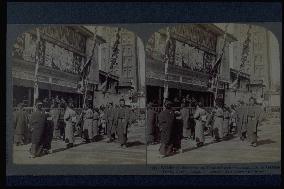
Egawa Taiseikan, famous for its girls doing acrobatics on balance balls. Some of the girls are looking out onto the street. Formerly rice paddies owned by Sensoji Temple, the Asakusa Sixth District was filled in with soil from the digging of Oike in 1883 and became the largest entertainment district in Japan after the mid-Meiji Period. The tower in the background is Ryounkaku, also called Asakusa Junikai (Twelve Stories). An introduction to the tower is written on the white signboard to the right. This stereograph dates from 1904.==Date:1904, Place:Tokyo, Photo:Underwood, (Credit:Nagasaki University Library/Kyodo News Images) [Cabinet Number97‐68‐0]

  •  
Eruption of Mt. Asama

Eruption of Mt. Asama

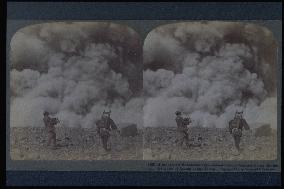
Mt. Asama is a three-layered composite volcano. This photograph captures a researcher taking shots of the smoke and his assistant at the edge of the mouth of Mt. Kamayama (2568m), the central crater. Official record keeping of Mt. Asama eruptions started only after 1886. This photograph was taken in 1904, during a lull in the mid-Meiji Period (1894-1908) when volcanic activity was relatively minor. ==Date:1904, Place:Nagano, Photo:Underwood, (Credit:Nagasaki University Library/Kyodo News Images) [Cabinet Number97‐61‐0]

  •  
Going down the Hozu River

Going down the Hozu River

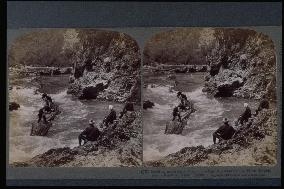
A raft shooting rapids is seen from the northern shore of the Hozu River. Boatmen are sitting on the rocks observing the scene. People took the approximately 16km boat ride from Hozu Town in Kameoka to Togetsu Bridge in Arashiyama. The river boats that carried lumber and goods from Tanba Kameoka to Kyoto were converted to leisure boats at the end of the Meiji Period when the Kyoto Railway was established. This may have been taken by the British photographer H. G. Ponting.==Date:1904, Place:Kyoto, Photo:Underwood, (Credit:Nagasaki University Library/Kyodo News Images) [Cabinet Number97‐26‐0]

  •  
Osaka Castle

Osaka Castle

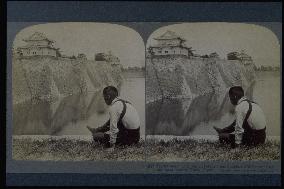
Rokuban Yagura (No.6 Watchtower) is on the right, and Sanban Yagura (No.3 Watchtower) is visible behind the bridge. Originally, there were seven watchtowers. However, they were destroyed during World War II air raids in 1945, and only number one and six remain today. Probably taken at the end of the Meiji Period.==Date:1904, Place:Osaka, Photo:Underwood, (Credit:Nagasaki University Library/Kyodo News Images) [Cabinet Number97‐19‐0]

  •  
Stone Lantern in Sumiyoshi Shrine

Stone Lantern in Sumiyoshi Shrine

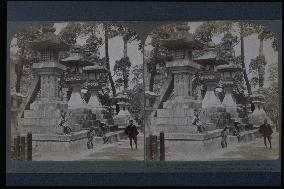
Many stone lanterns were donated to Sumiyoshi Shinto Shrine as prayers for safe sea voyages and successful business. Probably taken in the beginning of the Meiji Period.==Date:1904, Place:Osaka, Photo:Underwood, (Credit:Nagasaki University Library/Kyodo News Images) [Cabinet Number97‐18‐0]

  •  
Soribashi bridge at Sumiyoshi Shrine

Soribashi bridge at Sumiyoshi Shrine

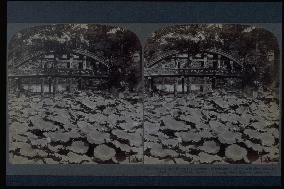
This stereograph depicts Soribashi Bridge and the lotus pond. The parapets of Yorubehashi seem different from those depicted in photograph #4595, indicating that this photograph was taken sometime later. Latter half of the Meiji Period.==Date:1904, Place:Osaka, Photo:Underwood, (Credit:Nagasaki University Library/Kyodo News Images) [Cabinet Number97‐11‐0]

  •  
Yokohama Post Office

Yokohama Post Office

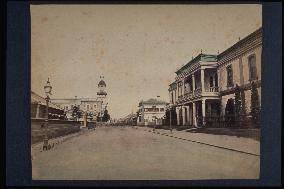
The building across Honcho Dori is the Yokohama Post Office built in 1875 (presently part of the Prefectural Office grounds). The building next door is the Telegraph Station built in 1872. Since both were reconstructed in brick in the third decade of the Meiji Period, this photograph must have been taken prior to that time. The clock tower is the Yokohama Town Meeting Hall (present-day Yokohama Archives of History Memorial Hall).==Date:unknown, Place:Yokohama, Photo:unknown, (Credit:Nagasaki University Library/Kyodo News Images) [Cabinet Number96‐104‐0]

  •  
Practicing the koto and shamisen

Practicing the koto and shamisen

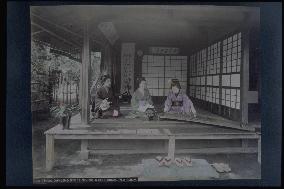
One can almost hear the sounds of the shamisen lute and koto harp being tuned. The people of the Meiji Period heard these sounds frequently in their living environment. This trio may be rehearsing for a recital in an annex guest room.==Date:unknown, Place:unknown, Photo:unknown, (Credit:Nagasaki University Library/Kyodo News Images) [Cabinet Number96‐84‐0]

  •  
The entrance to Mt. Nunobiki

The entrance to Mt. Nunobiki

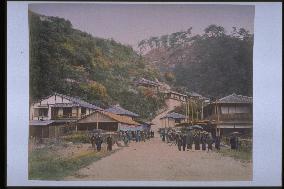
The start of the trail to Nunobiki Falls taken in mid-Meiji Period. The hill on the right is Mt. Isago. Ikuta River runs between the two hills. The Medaki (Female Waterfall) is located at the top of the path to the left. This is the same as photograph #2821, only tinted differently. The composition featuring people posing in the midst of famous scenery as if for a commemorative photograph is typical of Kusakabe Kinbei.==Date:about 1885, Place:Kobe, Photo:Kusakabe Kinbei, (Credit:Nagasaki University Library/Kyodo News Images) [Cabinet Number96‐68‐0]

  •  
Priests

Priests

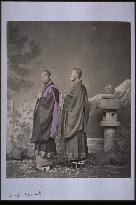
This Yokohama photograph is entitled (in pen), Priests- Buddhists and shows two young priests. The studio backdrop suggests that it was taken by Stillfried in the early Meiji Period.==Date:about 1870, Place:unknown, Photo:F. Beato, (Credit:Nagasaki University Library/Kyodo News Images) [Cabinet Number96‐72‐0]

  •  
Daibutsu (the Great Buddha) of Kamakura

Daibutsu (the Great Buddha) of Kamakura

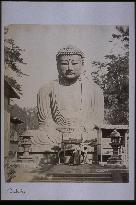
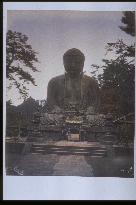
The words STILLFRIED(?) C. 1875 are visible on the mount. This photograph is said to have been taken by Stillfried around 1875, but the presence of the same temporary shack as that in photograph #2748 and the signboard on the left reading Names of Donors for Reconstruction Work suggest that it was taken a little later, probably the second decade of the Meiji Period.==Date:about 1875, Place:Kamakura, Photo:R. Stillfried, (Credit:Nagasaki University Library/Kyodo News Images) [Cabinet Number96‐70‐0]

  •  
A woman holding an umbrella

A woman holding an umbrella

The striped pattern of the kimono worn by this woman was popular during the Edo Period. She is holding a bangasa umbrella in her right hand. The sash she is wearing, called chuya-obi, was popular from the end of the Edo Period to the early years of Meiji.==Date:about 1864-1868, Place:unknown, Photo:unknown, (Credit:Nagasaki University Library/Kyodo News Images) [Cabinet Number96‐63‐0]

  •  
Dance lesson

Dance lesson

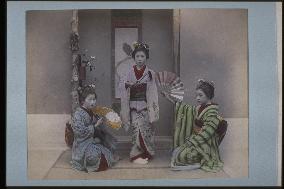
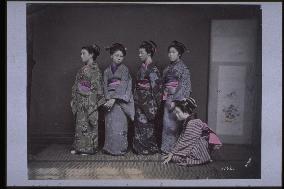
Geiko apprentices practice dancing. The apprentices were called hangyoku (half gems) or hinagi (fledgling entertainers). This is a scene from the early Meiji Period.==Date:unknown, Place:unknown, Photo:unknown, (Credit:Nagasaki University Library/Kyodo News Images) [Cabinet Number96‐58‐0]

  •  
The torii gate of Yasukuni Shrine

The torii gate of Yasukuni Shrine

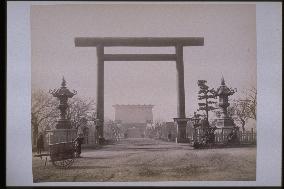
The bronze Otorii was erected in 1887 after the old wooden torii built in 1873 was removed. The lanterns on both sides of the gate were donated by the police and called the Police Department Golden Lanterns. The building in the centre is the main hall unveiled on May 19, 1872. Mid-Meiji Period.==Date:unknown, Place:Tokyo, Photo:unknown, (Credit:Nagasaki University Library/Kyodo News Images) [Cabinet Number96‐52‐0]

  •  
A distant view of the city of Kobe

A distant view of the city of Kobe

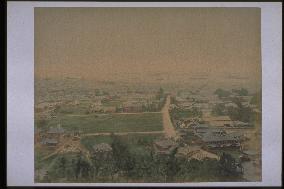
View of Kobe harbour from Mt. Suwa. Mid-Meiji Period. This is the same as photograph #4485, although the tinting of the buildings is different. The house surrounded by walls on the right of the main street running north-south is the residence of Kodera Yasujiro. The City of Kobe acquired this house in 1941 and named it Sorakuen. Yasujiro was a retainer of the Kuki family in the Sanda feudal domain. His first son, Kenkichi, became the first elected mayor of Kobe City in 1947.==Date:unknown, Place:Kobe, Photo:unknown, (Credit:Nagasaki University Library/Kyodo News Images) [Cabinet Number96‐46‐0]

  •  
The Iris Garden,Isogo

The Iris Garden,Isogo

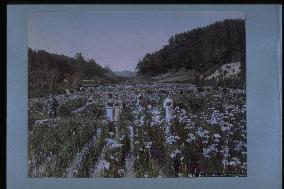
Growing flowers to be shipped to central Tokyo became popular in Isoko, Okamura, and Tomioka from mid-Meiji Period on and some of the flowers were exported. Isoko was famous from ancient times for its flower production, including the Sugita plum grove, but the iris garden at Masaka in Yokohama became a popular spot for locals and visitors from around the middle of the Meiji Period.==Date:unknown, Place:Yokohama, Photo:unknown, (Credit:Nagasaki University Library/Kyodo News Images) [Cabinet Number96‐47‐0]

  •  
Nunobiki Falls

Nunobiki Falls

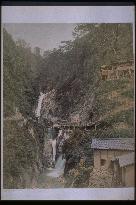
Medaki waterfall at Nunobiki Falls, taken sometime between the early and mid-Meiji Period. Although it is tinted differently, this is the same as photograph #2807, #4481 and #4682. The flow from Odaki to Medaki turns into the Shin Ikuta River and eventually pours into the sea. Many water mills for polishing rice were located downstream from this area.==Date:unknown, Place:Kobe, Photo:unknown, (Credit:Nagasaki University Library/Kyodo News Images) [Cabinet Number96‐45‐0]

  •  
Dejima and Nagasaki harbour seen from Don-no-Yama

Dejima and Nagasaki harbour seen from Don-no-Yama

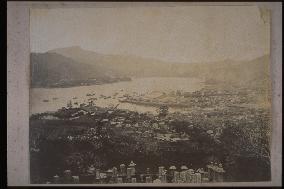
Junin-machi, the Shinchi warehouses, Dejima, Edo-machi, and the Nagasaki Harbour area seen from the hillside behind the foreign settlement of Higashiyamate. The presence of the Dejima-Shinbashi Bridge linking Dejima and Tsuki-machi indicates that the photograph was taken in the beginning of the Meiji Period.==Date:unknown, Place:Nagasaki, Photo:R. Stillfried, (Credit:Nagasaki University Library/Kyodo News Images) [Cabinet Number96‐38‐0]

  •  
A fire brigate getting together in front of the fire tower

A fire brigate getting together in front of the fire tower

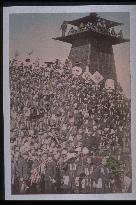
Police firefighters gathered at Kajibashi in front of the fire watch tower. It was the duty of the police headquarters fire department to fight fires. When it was established in the Meiji Period, the Fire Department assumed control over the 48 groups of firefighters in the city, and these came under police management when the Police Headquarters was established in 1874. All the people, some of them on the watchtower and the roof, can be made out. Because of the nature of their job, these firefighters could pose anywhere. This is probably January 4, 1875, the day of the first inauguration ceremony.==Date:unknown, Place:Tokyo, Photo:unknown, (Credit:Nagasaki University Library/Kyodo News Images) [Cabinet Number96‐16‐0]

  •  
Women waiting for their turn

Women waiting for their turn

This hairstyle, called tenjinmage, was popular from the end of the Edo Period to the Meiji Period. The hair is arranged in an ordinary fashion, and the style of dress suggests that the women are novice workers beginning to learn their trade.==Date:unknown, Place:unknown, Photo:Usui Shuzaburo, (Credit:Nagasaki University Library/Kyodo News Images) [Cabinet Number94‐9‐0]

  •  
Daibutsu (the Great Buddha) of Kamakura

Daibutsu (the Great Buddha) of Kamakura

The photograph bears the inscription One Hundred Nineteen 119. There are no bronze lotus petals. The building on the right side of the statue is probably the same as that in photograph #3997. The sharply-raking finials on the two bronze lanterns in front of the statue indicate that this photograph was taken at the beginning of the Meiji Period, but there seems to be a slight time difference from photograph #3997.==Date:unknown, Place:Kamakura, Photo:Usui Shuzaburo, (Credit:Nagasaki University Library/Kyodo News Images) [Cabinet Number94‐10‐0]

  • Main
  • Top
  • Editorial
  • Creative
  • About Us
  • About ILG
  • Terms of use
  • Company
  • BEHIND
  • Price List
  • Single Plan
  • Monthly Plan
  • Services
  • Shooting
  • Rights Clearance
  • Support
  • FAQ
  • How To Buy
  • Contact Us
  • Become a Partner

© KYODO NEWS IMAGES INC

All Rights Reserved.

  • Editorial
  • Olympics
  • News
  • Sports
  • Japan
  • Tech
  • Royal
  • Disaster
  • NorthKorea
  • Old Japan
  • SNS
  • Creative
  • Food
  • Japan
  • Landscape
  • Animal
  • Popular
  • #Ukraine
  • #China
  • #coronavirus
  • #N. Korea
  • #Thailand
  • #Russia
  • #Ukraine
  • #China
  • #coronavirus
  • #N. Korea
  • #Thailand
  • #Russia
  • Food
  • Japan
  • Landscape
  • Animal
  • Olympics
  • News
  • Sports
  • Japan
  • Tech
  • Royal
  • Disaster
  • NorthKorea
  • Old Japan
  • SNS